Is It Illegal To Interact With Wild Dolphins In South Australia?
Swimming up to wild dolphins in South Australia is regulated, not forbidden. This guide explains the 2025 marine mammal rules, the 30 m swimmer distance, the AUD 315 expiation fee, and which tours are legal.
No, it is not illegal to be in the water near wild dolphins in South Australia, but it is heavily regulated. The National Parks and Wildlife (Protected Animals, Marine Mammals) Regulations 2025, in force since 1 September 2025, set distance limits for swimmers and boats, prohibit feeding and touching, and require any operator charging money to take people near dolphins to hold a Ministerial permit. Breaching the swimmer rules carries an expiation fee of AUD 315 per alleged offence.
The question usually arrives in one of two forms. Either someone has seen dolphins close to shore and wonders whether they can paddle out to them, or they are researching a paid swim and want reassurance that the operator is operating within the law. Both are fair questions, and the regulations give a clear answer to each, though the wording surprises people who expect a simple yes or no.
For the free-swimming case, the law does not stop you sharing the ocean with dolphins. What it does is draw precise boundaries around that encounter: how close you may approach, how long you may stay nearby, and what you may never do. For the paid case, the structure is different. A commercial operator may not legally take paying customers into the vicinity of a marine mammal to observe it or swim near it without a permit or other lawful authority, which is why licensed tours exist at all.
The full text of the regulations is published by the South Australian government at the legislation.sa.gov.au consolidated PDF, and it is worth reading the swimmer provisions yourself if the details matter to you. What follows is a plain-language walk through those rules, plus a look at how the licensed tours that operate from Glenelg and Kangaroo Island fit inside them.
What Exactly Do The Regulations Prohibit?
The regulations prohibit commercial marine mammal encounters, not casual swimming. Under Regulation 19, it is an offence to use a vessel or any other means, for fee or reward, to take another person into the vicinity of a marine mammal so that person can observe it or swim near it, or to assist such a person, without a Ministerial permit or other lawful authority.
This is the provision that decides whether a tour you are considering is legitimate. A company cannot simply buy a boat, load passengers and drop them beside a pod. It needs lawful authority, and the permit pathway runs through the National Parks and Wildlife Act 1972, under which conduct that would otherwise breach the regulations is allowed with a Ministerial permit. So when you see a dolphin swim operating openly out of Glenelg or Penneshaw, season after season, with bookings and published schedules, that is a business built inside this framework rather than outside it.
For an individual in the water on their own account, the operative rules are the swimmer distances in regulation 14, which treats snorkelling as swimming. You must not go closer than 30 metres to a marine mammal. You must stay at least 150 metres away from a dolphin that shows disturbance, appears sick or injured, is stranded or entangled, or is a calf or pup. And you must not spend more than 30 minutes within 150 metres of a non-whale marine mammal. That 30-minute figure is a swimmer regulation written into the rules, not an operator policy or a permit condition.
One point of honesty about the public record: no permit register and no permit conditions, such as swimmer numbers or time allowed in the water, were found in any official source. So this article cannot tell you what a specific operator's permit says, and any page that claims to quote permit conditions it has not seen should be treated with caution. What can be verified is the law itself and what each operator says about its own trips.
A natural question is how the licensed swim tours manage the 30-metre rule when swimmers are, visibly, much closer than that to the animals. The answer lies in the structure of a permitted swim: the operator holds the authority that a private swimmer lacks, and the regulations permit activity under that authority. The Adelaide Swimming With Dolphins site exists largely to explain these distinctions, because the difference between a permitted controlled swim and a rogue approach is exactly the difference the law is drawing.
The permit structure also explains why swimming is not simply "allowed" in a free-for-all sense. The law draws a line between a person who happens to be in the sea and a person who is delivered to the dolphins for a fee. If you want the full breakdown of approach distances for every situation, the companion guide on dolphin swim rules and how close you can get covers the practical side, including what happens when dolphins approach you rather than the other way around.
How Close Can A Swimmer Legally Get?
A swimmer or snorkeller must keep at least 30 metres away from any marine mammal, and that buffer expands to 150 metres if the animal shows signs of disturbance, appears sick or injured, is stranded or entangled, or is a calf or pup; on top of that, a swimmer cannot stay within 150 metres of a non-whale marine mammal for more than 30 minutes.
The two regimes trip people up because the numbers differ. A boat must hold back 50 metres where a swimmer's baseline is 30, and the 150-metre buffer applies in both regimes for the same protective reasons: a calf in the pod, or an animal behaving as though it is unwell or harassed. There is also a speed rule for skippers, 4 knots within 150 metres, which is part of why permitted swim vessels move so slowly while swimmers are on the line.
What if a dolphin swims toward you? The law regulates what you do, not what the dolphin does. If you hold your position, or move away, you have not breached an approach rule; the offence lies in closing the distance yourself, cutting off an animal's path, or lingering past the time limit. The same logic applies to boats: the skipper's obligation is to maintain distance and speed limits regardless of how curious the pod is.
The sanctuary context is worth separating out, because search results often blur it. The Adelaide Dolphin Sanctuary is the Port River and Barker Inlet estuary north of Port Adelaide, home to a population the state's own environment department describes in its twenty facts for 20 years of the sanctuary. It is a different stretch of water entirely from the Glenelg swim area, and the Glenelg operator does not name its swim site, so no page should claim a specific location for it. For how the sanctuary rules work in practice, see whether you can swim in the Adelaide Dolphin Sanctuary.
Are Feeding And Touching Wild Dolphins Illegal?
Yes. Under the 2025 regulations, feeding a marine mammal and touching one are both prohibited, full stop, with no distance thresholds or exemptions for friendly animals. These are separate offences from the approach distances, so a swimmer who stays inside the 30-metre rule by the dolphins' own choice can still breach the law by reaching out or offering food. The expiation fee of AUD 315 per alleged offence applies here too.
Feeding is the more serious problem in practice, because it changes dolphin behaviour across a whole population, not just one encounter. A dolphin that learns to associate boats or swimmers with food begins approaching propellers, hanging around fishing lines and teaching the habit to calves. This is why the prohibition is absolute rather than graded by distance. The same reasoning sits behind the touch ban: contact, however gentle it looks, is a disturbance event from the animal's side of the exchange.
Curiosity cases get asked about constantly, and there is a dedicated post on whether you can touch wild dolphins during a swim that works through them. The short version is that the licensed swim operators are explicit about it: hands stay on the flotation line, and the crew's whole method is built around not pursuing or grabbing the animals. If a dolphin chooses to pass close to the line of swimmers holding on at the stern, that is the dolphin's decision, made inside a permitted framework.
The feed question has its own article on whether you can feed a wild dolphin, but the legal position needs stating plainly here because it is the clearest "yes, illegal" answer on the page. Offering food of any kind to a marine mammal in South Australian waters is a breach of the regulations whether you are on a boat, on a jetty or in the water, and it is the behaviour most likely to draw an expiation notice from a wildlife officer watching a popular spot.
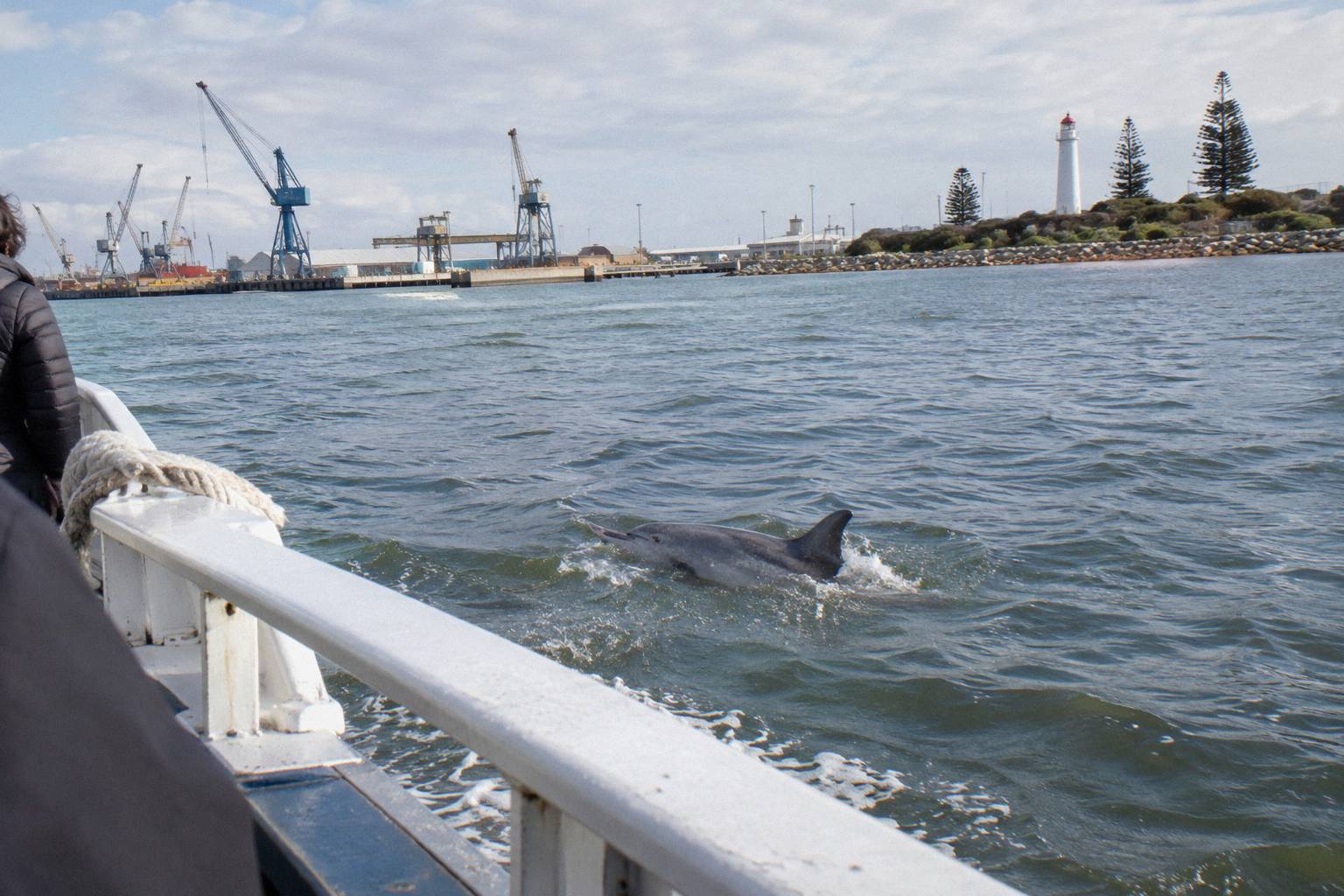
What Happens If You Break The Rules?
The enforcement mechanism is an expiation fee of AUD 315 per alleged offence under regulation 20 of the 2025 regulations. Each breach, an approach too close, a touch, feeding, a vessel inside its distance limit, can be expiated separately, so a single trip that breaches several rules can attract several fees. More serious matters can proceed beyond expiation, but the on-the-spot figure is the one written into the regulations.
The "per alleged offence" wording matters. It is not AUD 315 for a bad afternoon with dolphins; it is AUD 315 for each rule broken during that afternoon. A skipper who drives a vessel within 50 metres of a pod, then holds position while passengers hand out food, is accumulating distinct offences under distinct regulations. Wildlife officers in South Australia do patrol known dolphin areas, particularly the sanctuary waters near Port Adelaide where resident animals and recreational boats mix daily.
For an ordinary swimmer or kayaker, though, the realistic risk is not a fine but a misunderstanding. Somebody sees fins, swims out, and gets closer than 30 metres without knowing the number exists. The law's ignorance defence is thin, but the practical protection for most people is simply that wild dolphins usually control the encounter themselves. If you are unsure what to do when one appears, the guide on what to do if a dolphin swims up to you sets out the calm sequence: stop, hold position, let the animal choose, and leave the area steadily when it does.
How Do Licensed Dolphin Swim Tours Stay Legal?
Licensed dolphin swim tours stay legal through the permit authority in regulation 19 and section 68 of the National Parks and Wildlife Act 1972, which allows a fee-based operator to take customers into the vicinity of dolphins when a private boat could not. Inside that framework the operator controls the encounter: swimmers hold a line, entries happen only on the crew's call, and the vessel obeys the speed and distance rules for boats.
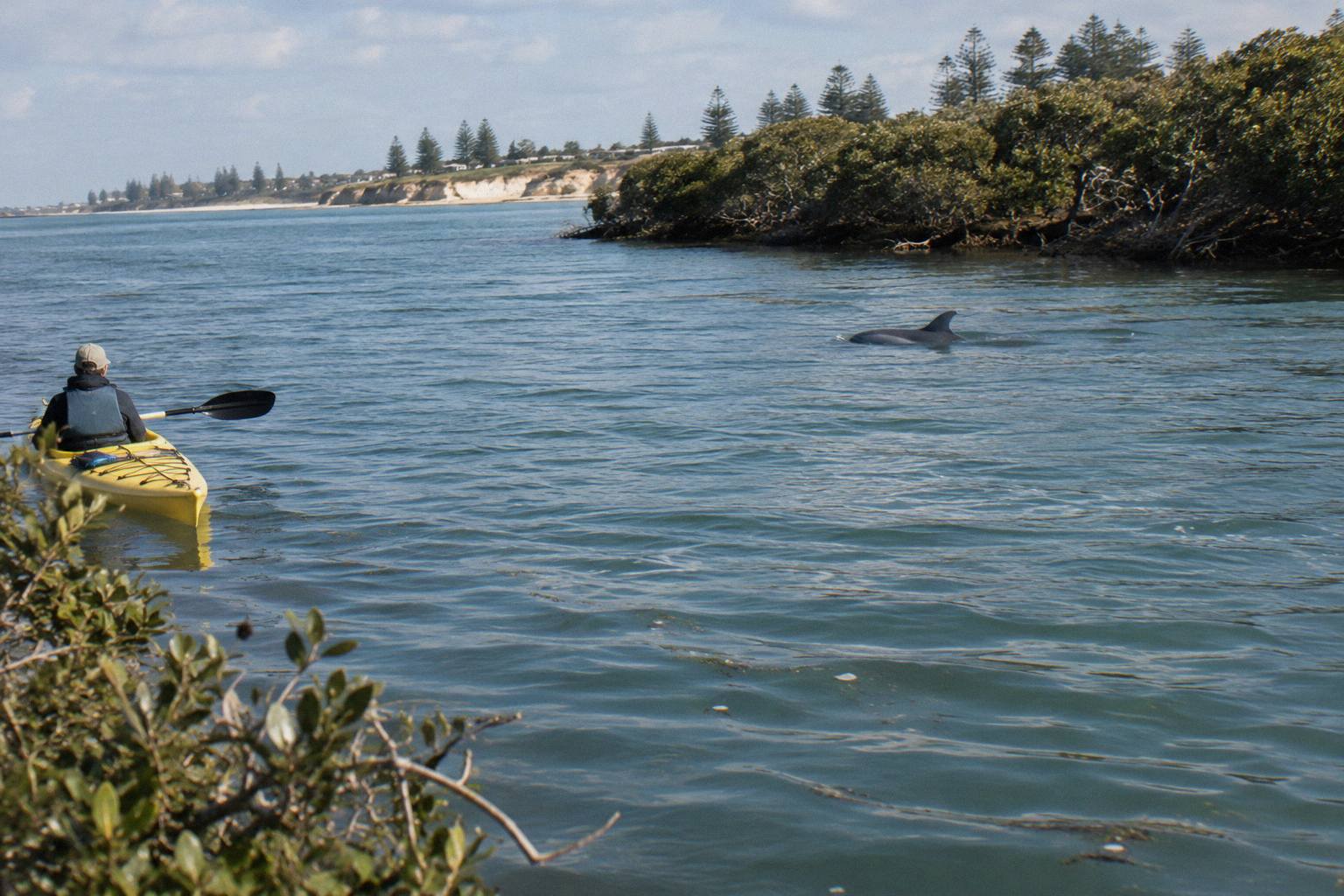
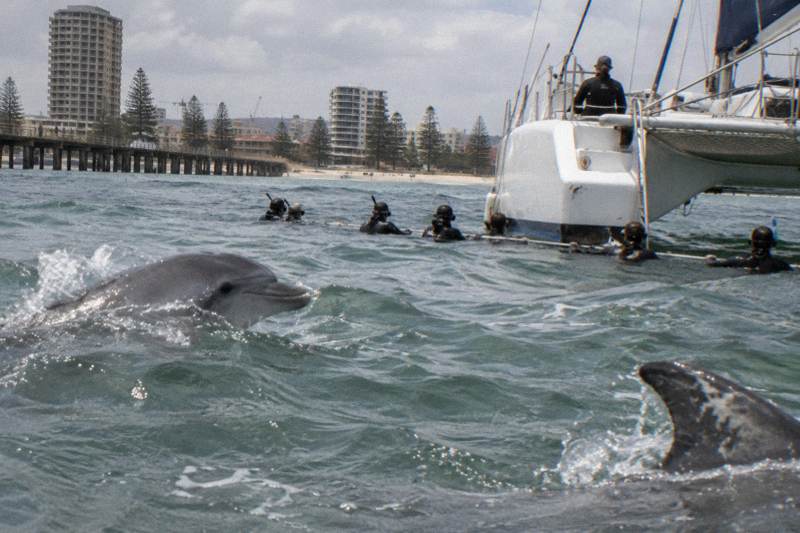
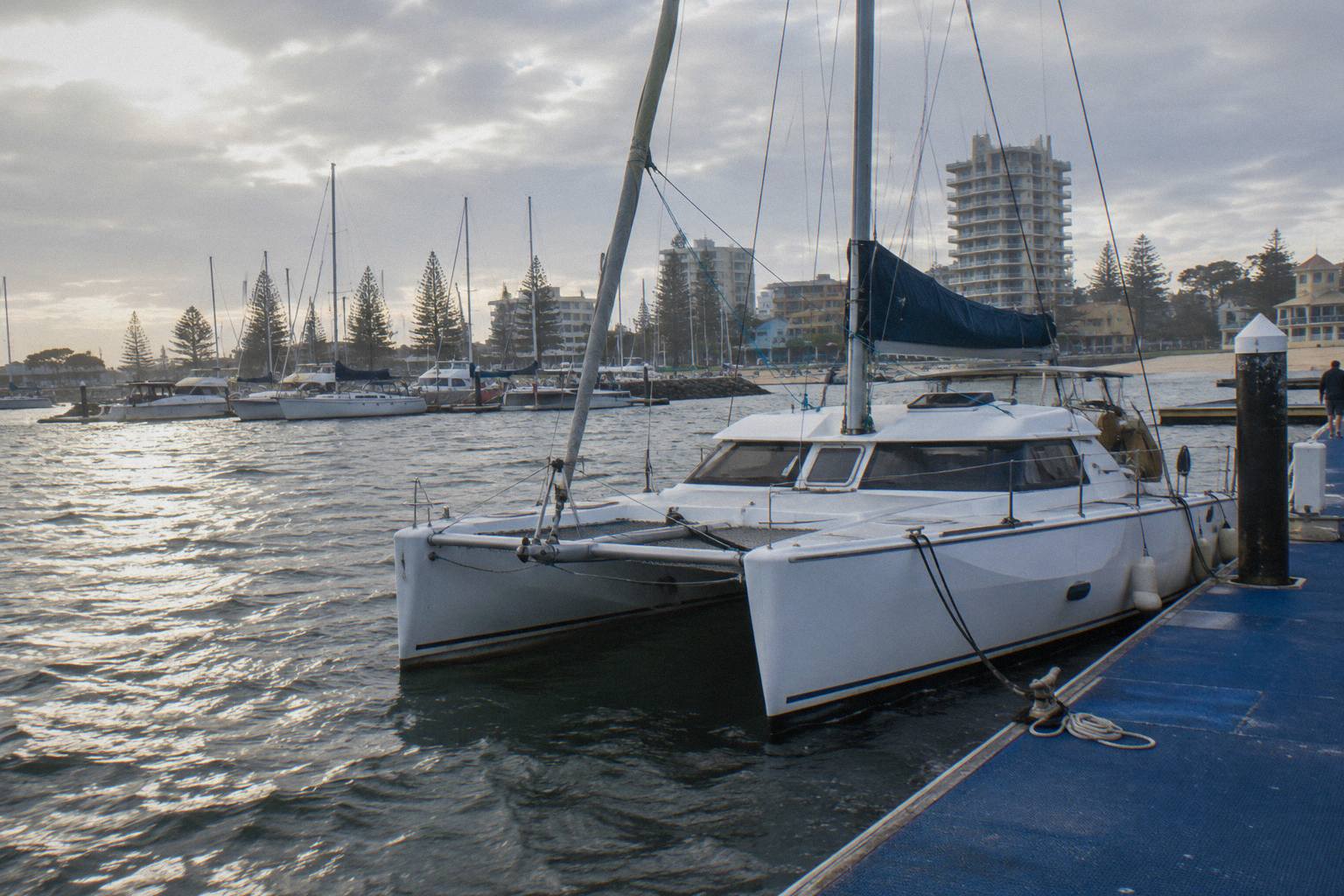
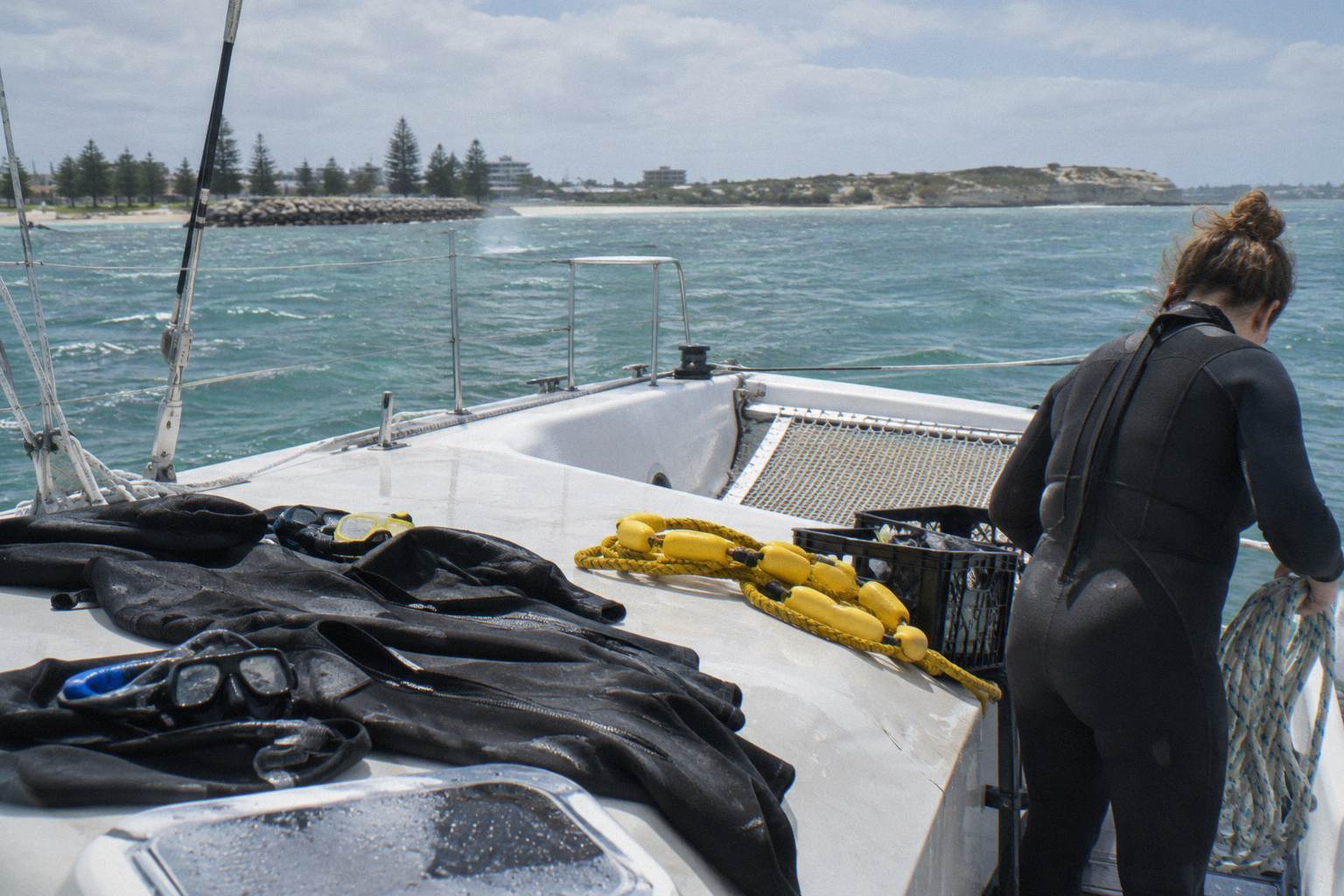
The practical version of this is easiest to see on the Glenelg trip. The operator, Temptation Sailing, describes its vessel as a 58 ft sailing catamaran surveyed for up to 50 passengers, boarding at Marina Pier, Holdfast Shores Marina, from 15 minutes before a morning departure. Each swimmer is fitted with a full-length 5 mm wetsuit that the operator says also acts as a flotation device, given a crew briefing of about 15 minutes, and then rotated between two swim experiences, the Front Swim and the Back Swim, both built around holding a flotation line connected to the stern while the boat moves slowly.
Crucially for the legality question, the operator's stated method is that the crew puts swimmers into the water only once dolphins have turned toward the boat, and stops entries when the dolphins get too close. That is a permitted, controlled swim, not free swimming in open ocean, and it is the difference between an encounter the regulations authorise and one they prohibit. The operator also says it has run dolphin swim and watch tours from Glenelg since 2002 and calls itself the first vessel in South Australia to be given a licence to swim with dolphins, a claim worth reading as the operator's own statement on its wild dolphin tour page, not as an independent finding.
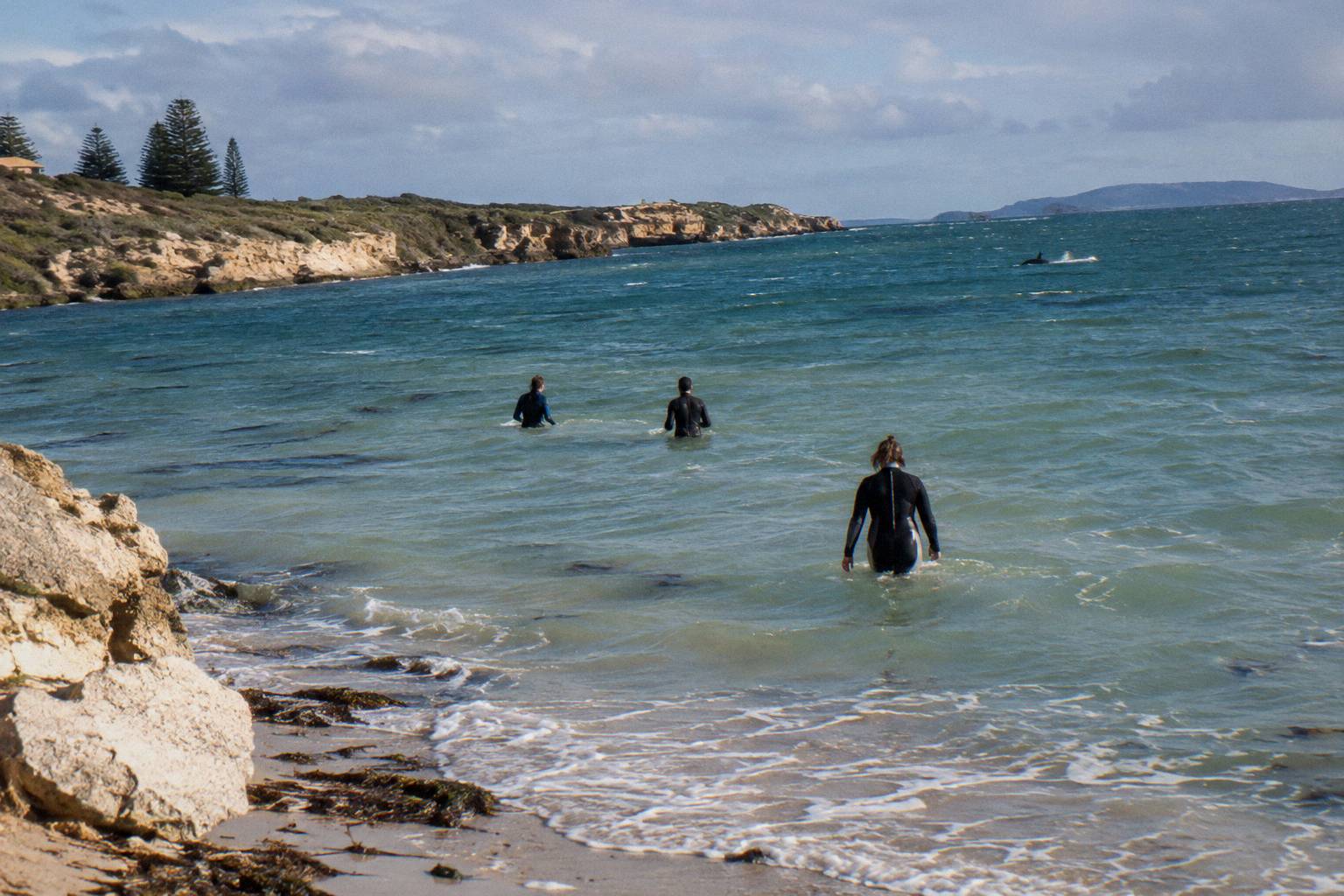
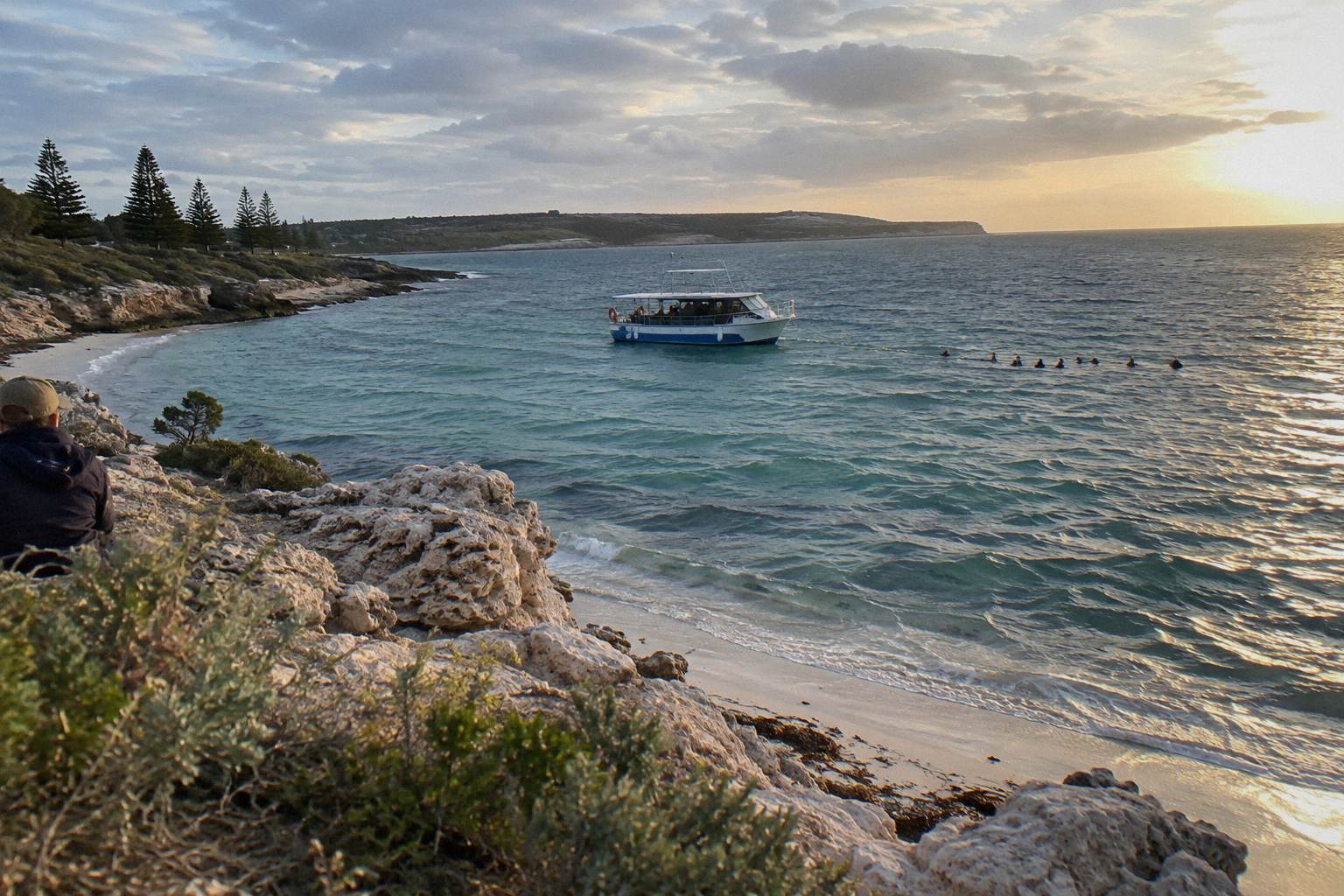
The Kangaroo Island product works the same legal way with a different method. The operator's two-hour Snorkelling Safari from Penneshaw is described as a swim with wild dolphins or among seals, with wetsuit, gloves, mask, snorkel and fins provided, a swimmer line with buoys often used at the back of the vessel, shark shields fore and aft, and a meet time of 30 minutes before departure at the Kangaroo Island Information Stop for fitting and a safety brief. Reasonable swimming ability is recommended, the swim starts from age 9, and it is not suitable with a pacemaker or in pregnancy. Because the trip may turn out to be dolphins only, seals only or a coastal snorkel, the operator is blunt that wildlife interactions are not guaranteed.
That honesty matters for a page about the law, because the guarantee people sometimes imagine, a promised dolphin encounter, is exactly what a responsible permitted operator cannot and will not promise. The Glenelg operator's much-quoted "100% success rate of seeing dolphins onboard since 2002" is an above-water sighting claim on the operator's own direct-booking terms, never a promise of dolphins underwater beside you. For the full picture, the guide on dolphin swim sightings and what if none appear compares the operators' terms line by line.
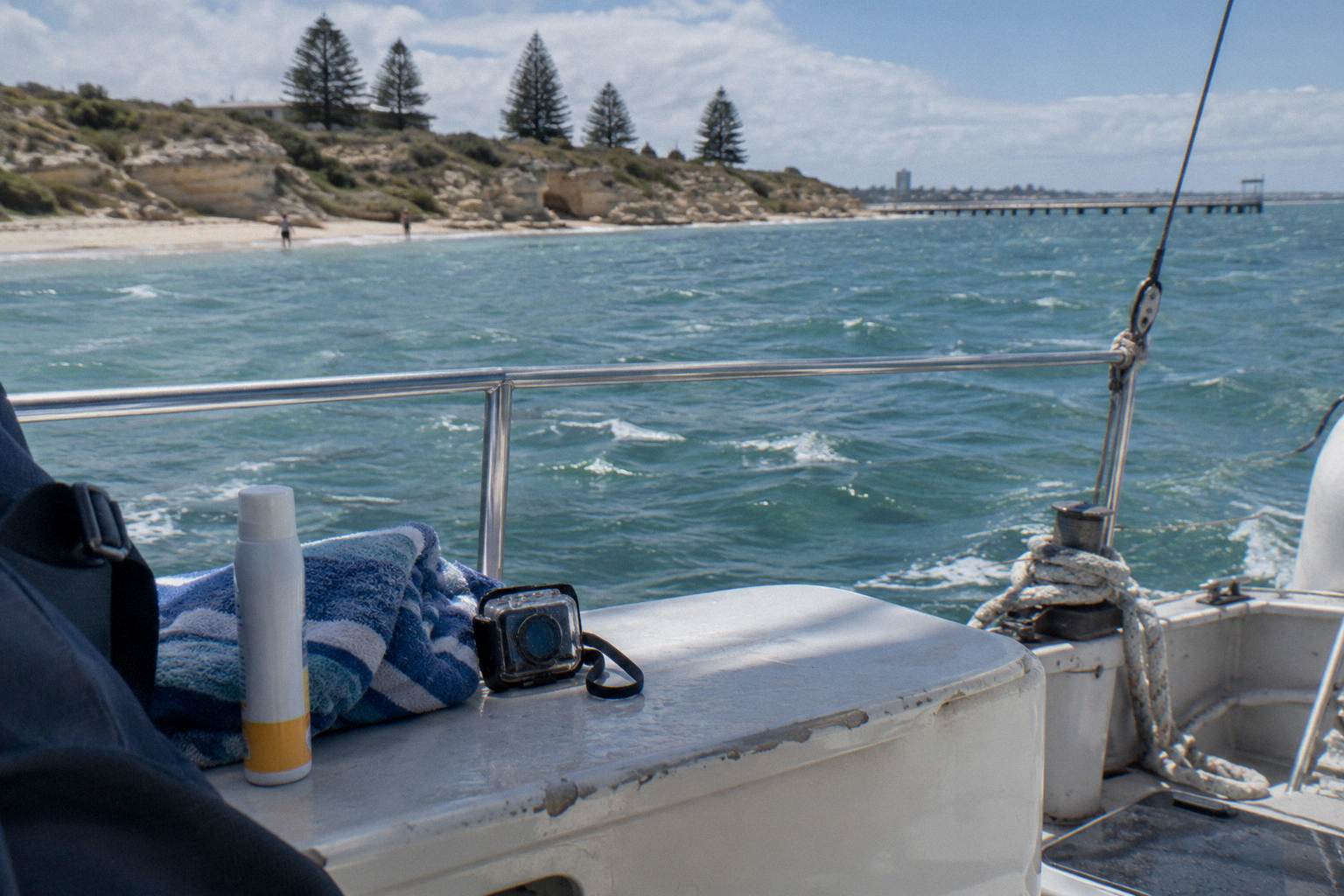
Which Tours Are Watching Only, And Does The Law Treat Them Differently?
Yes, watching trips are regulated as vessel activity, so the 50-metre boat distance, the 150-metre calf and disturbance buffer and the 4-knot speed rule apply, but no swimmer rules are engaged because nobody enters the water. On this site's roster, the Wild Dolphin Watch From Glenelg cruise, the Port River Dolphin Cruise, the Dolphin Sanctuary Kayak Tour and the Kangaroo Island Dolphin Watch are all watching or paddling products with no in-water dolphin swim component.
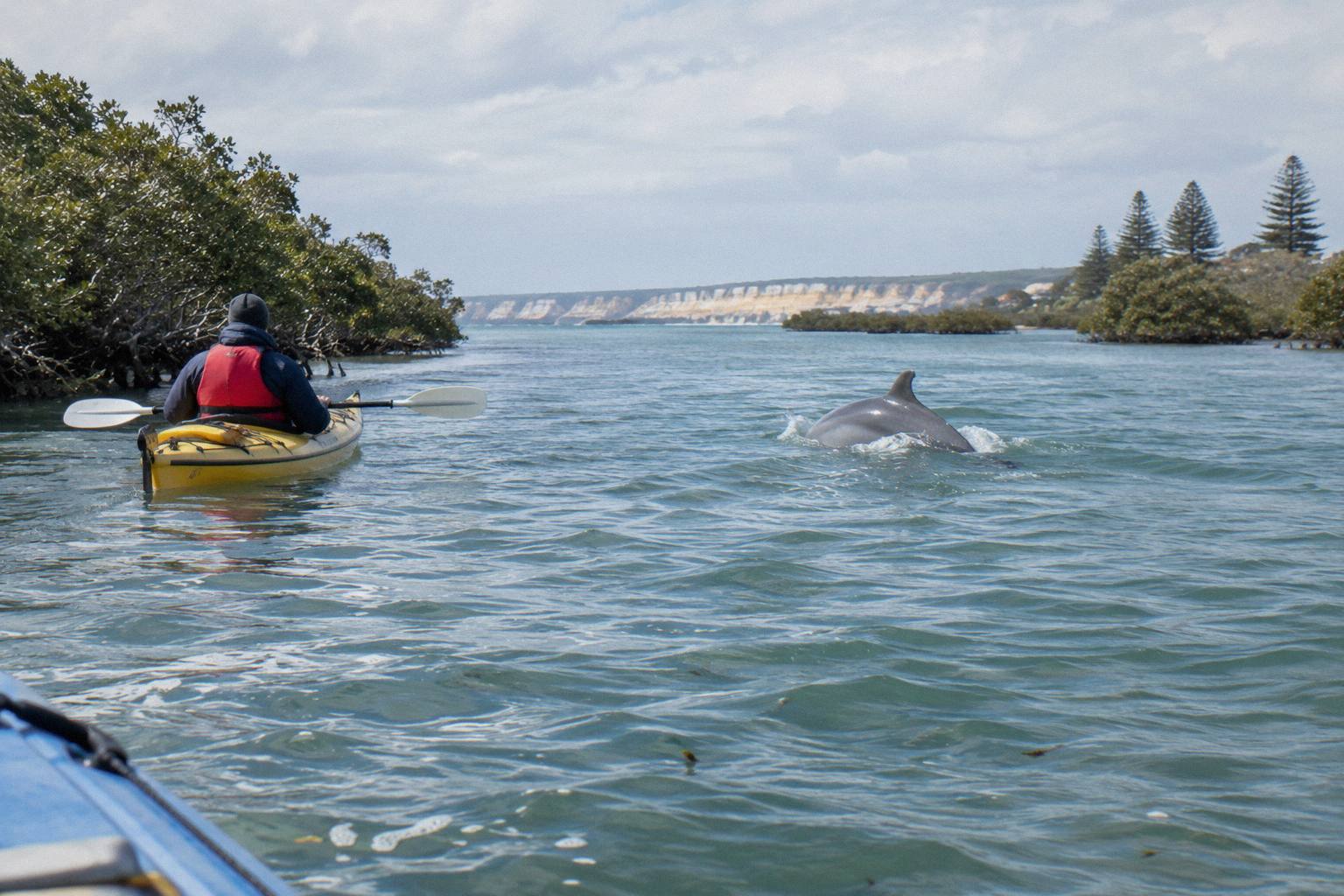
The distinction is practical for a reader weighing legality against comfort. A watching cruise carries the same permit requirement on the operator's side, since taking paying passengers near dolphins to observe them is precisely what regulation 19 covers, but the passenger's own conduct is passive: you stay aboard, and the skipper manages every distance. The paddling option, the Dolphin Sanctuary Kayak Tour operated by Adventure Kayaking SA, sits closer to the swimmer rules because you are in the water column in a vessel of your own, in sanctuary waters where resident dolphins are common, which is why its guides manage group behaviour so carefully.
| Tour | Experience | Rating | From (USD) | Duration |
|---|---|---|---|---|
| Wild Dolphin Swim From Glenelg With Temptation Sailing | In-water swim | 4.7 from 493 reviews | 104 | about 4 hours |
| Kangaroo Island Ocean Safari Swim | In-water swim | 4.4 from 137 reviews | 132 | 2 hours |
| Wild Dolphin Watch From Glenelg | Watching only | 4.8 from 409 reviews | 62 | listed about 3.5 hours |
| Port River Dolphin Cruise | Watching only | 4.5 from 481 reviews | 60 | 1.5 hours |
| Dolphin Sanctuary Kayak Tour | Paddling only | 4.8 from 300 reviews | 54.72 | on the listing |
| Kangaroo Island Dolphin Watch | Watching only | 4.8 from 640 reviews | 61.74 | about 1 hour 15 minutes |
For the swim-curious but nervous, the watching trips are not a consolation prize; they are the same waters, often the same boat in Glenelg's case, since the operator runs swim and watch guests on one catamaran that can be booked together or separately. The roster's free-cancellation position is also broadly consistent: every product above carries free cancellation up to 24 hours before departure, except the Kangaroo Island Dolphin Watch, whose booking page marks it non-refundable. Checking the live listing before you commit is simply good practice.
| Behaviour | Legal status for a private swimmer | Key figure |
|---|---|---|
| Swimming near a wild dolphin on your own | Allowed, distance-limited | 30 m minimum |
| Staying near a disturbed, sick, stranded or entangled dolphin, or a calf | Prohibited within the buffer | 150 m |
| Remaining within 150 m of a non-whale | Time-limited | 30 minutes max |
| Feeding a wild dolphin | Prohibited | expiation fee AUD 315 |
| Touching a wild dolphin | Prohibited | expiation fee AUD 315 |
| Taking paying customers near dolphins | Lawful only under a permit | section 68 authority |
Does The Water Quality Affect Whether Swims Go Ahead?
Legality and water quality are separate questions, but both bear on a booking. State testing shows zero or low Karenia algae along the metropolitan coast, Kangaroo Island, the Southern Fleurieu and offshore Gulf sites, and the official health advice is that clear water is fine to swim in, while foamy or abnormally coloured water should be avoided. The Glenelg operator still carries a notice that the bloom may affect its tours, so check the operator before booking a swim.
The distinction to keep straight is that no regulator has declared anything "over". The state's monitoring agencies continue to watch for future blooms while reporting the current low levels, and the official health guidance is refreshingly concrete: beaches can still be enjoyed, rinse afterwards, and if the water is clear it is fine to swim. The operator-side notice matters because a permitted swim is a commercial activity with its own assessment duties, and the Glenelg operator states that it assesses algae concentration ahead of the season, with a full refund if it cancels.
For a booking decision, the practical sequence is simple. Read the tour's live listing, check whether any water-quality notice is current on the operator's own page, and note the cancellation terms for the specific product. The Wild Dolphin Watch From Glenelg cruise, rated 4.8 across 409 reviews and from USD 62 per person, gives you the above-water experience with the same free cancellation up to 24 hours, which suits anyone whose appetite for the in-water version depends on conditions on the day.
Common Questions About Interacting With Wild Dolphins In South Australia
Is It Illegal To Interact With Wild Dolphins In South Australia?
Interacting is regulated rather than illegal in a blanket sense. Swimming near dolphins on your own account is allowed within the distance rules, at least 30 metres, widening to 150 metres in the stated protective cases, with a 30-minute cap within 150 metres of a non-whale. Feeding and touching are prohibited outright, and any operator charging to take people near dolphins must hold a permit.
Can You Swim Up To A Wild Dolphin Yourself?
You may share the water with wild dolphins, but you must not approach closer than 30 metres, must keep 150 metres from a calf or a dolphin showing disturbance, sickness, injury, stranding or entanglement, and must not stay within 150 metres of a non-whale for more than 30 minutes. Snorkelling counts as swimming under the regulations.
What Is The Fine For Getting Too Close To A Dolphin?
The regulations set an expiation fee of AUD 315 per alleged offence. Because it applies per offence, a single encounter that breaches more than one rule, such as approaching too close and then touching, can attract more than one fee.
Is It Illegal To Feed Or Touch A Dolphin?
Yes, both are prohibited by the marine mammal regulations, with no distance thresholds or exceptions for calm, friendly animals. The prohibition is absolute because feeding changes dolphin behaviour across a population and contact counts as disturbance.
How Do Commercial Dolphin Swim Tours Stay Legal?
A fee-based swim is lawful only under a Ministerial permit or other lawful authority under section 68 of the National Parks and Wildlife Act 1972. Permitted operators run controlled swims in which swimmers hold a flotation line and enter only when the crew calls it, with the vessel obeying the boat distance and speed rules. Permit conditions themselves are not published in the official sources read for this article.
Are Dolphin Watching Cruises Covered By The Same Law?
Yes. Taking paying passengers near a marine mammal to observe it is exactly what the permit requirement covers, so watching cruises operate under the same authority. The difference is that passengers stay aboard, so only the vessel rules, 50 metres minimum, 150 metres with a calf or disturbance, and 4 knots within 150 metres, are engaged.